
 By lina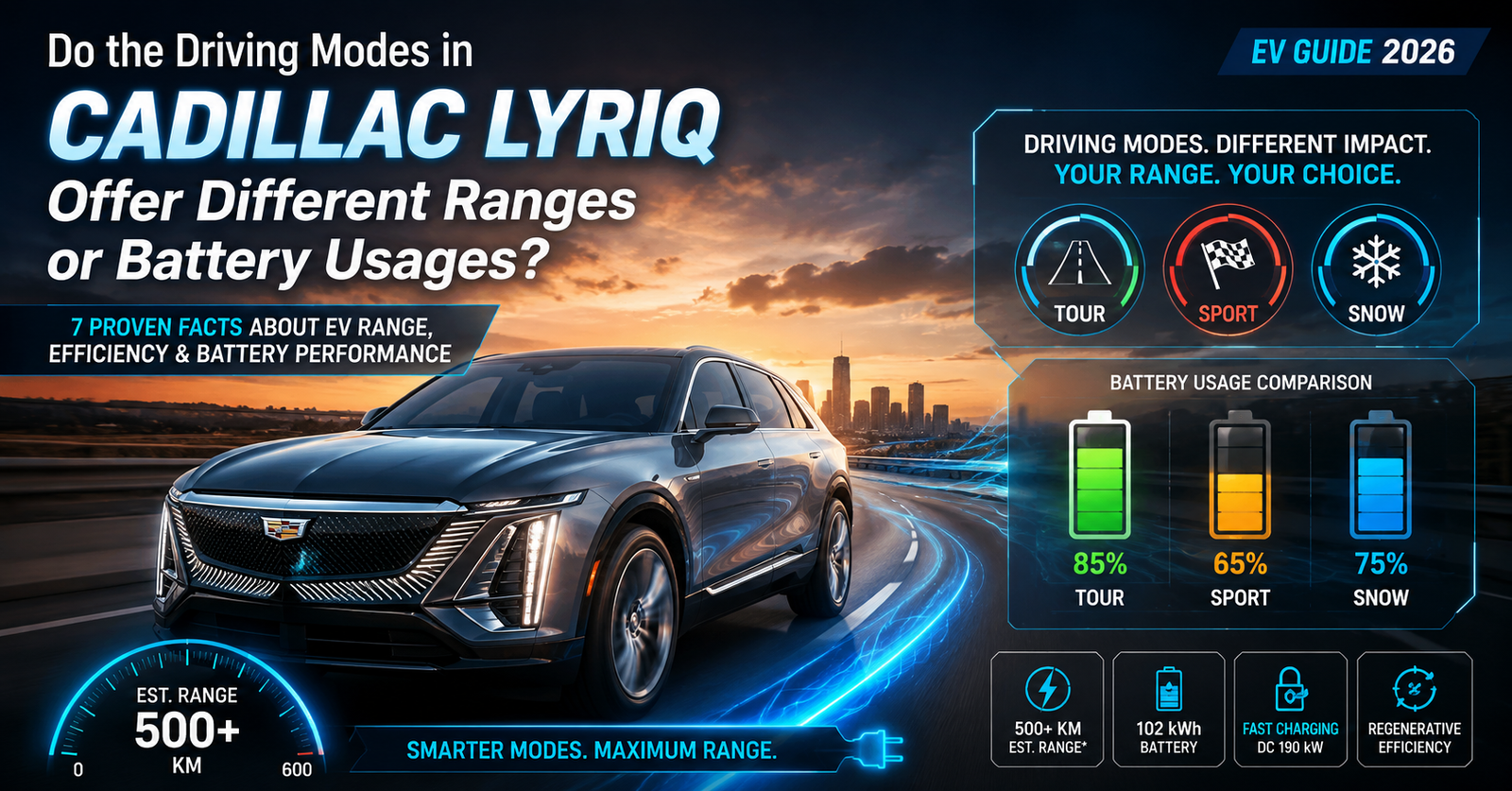
Do the driving modes in Cadillac Lyriq offer different ranges or battery usages? This is one of the most common questions among electric vehicle owners and potential buyers considering the Cadillac Lyriq. Driving modes are designed to change how a vehicle responds to acceleration, steering, braking, and energy management. While many drivers assume these modes dramatically alter battery capacity, the reality is more nuanced. Different driving modes can influence energy consumption and efficiency, which may indirectly affect the vehicle’s driving range. Understanding how these systems work can help drivers maximize efficiency and get the most out of every charge.
| Driving Mode | Main Purpose | Effect on Energy Usage | Potential Impact on Range |
|---|---|---|---|
| Tour Mode | Everyday driving comfort | Balanced energy consumption | Standard range performance |
| Sport Mode | Faster acceleration and responsiveness | Higher energy consumption during aggressive driving | May reduce range |
| Snow/Ice Mode | Improved traction in slippery conditions | Controlled power delivery | Slight effect depending on road conditions |
| One-Pedal Driving | Increased regenerative braking | Better energy recovery | Can improve efficiency |
| Custom Settings | Driver-selected preferences | Varies based on configuration | Depends on driving habits |
The Cadillac Lyriq is Cadillac’s luxury electric SUV built on General Motors’ advanced electric vehicle platform. It combines premium comfort, modern technology, and impressive electric driving capabilities. One of its notable features is the availability of different driving modes that allow drivers to tailor the vehicle’s performance to various conditions and preferences.
When discussing whether driving modes affect range or battery usage, it is important to understand that the battery itself does not change. The total battery capacity remains the same regardless of the selected mode. What changes is how efficiently the vehicle uses the stored energy.
Driving modes influence several vehicle systems, including throttle response, regenerative braking behavior, traction control settings, steering feel, and power delivery. These changes can result in different energy consumption rates during operation.
Electric vehicle range depends on numerous factors beyond driving modes. These include:
- Vehicle speed
- Driving style
- Outside temperature
- Road conditions
- Tire pressure
- Passenger and cargo weight
- Use of climate control systems
- Terrain and elevation changes
Driving modes interact with some of these factors by modifying vehicle behavior. Therefore, while driving modes can affect efficiency, they are only one piece of the overall range equation.
Tour Mode is generally considered the default driving mode in the Cadillac Lyriq. It is designed to provide a balanced driving experience suitable for everyday use.
In this mode, acceleration is smooth and predictable. Steering is calibrated for comfort, and power delivery is optimized for efficient daily driving. Because Tour Mode avoids aggressive power demands, it often represents the most balanced option between performance and efficiency.
For most drivers, Tour Mode offers a practical combination of comfort and energy conservation. As a result, it frequently delivers range figures that closely match official manufacturer estimates under normal driving conditions.
Sport Mode changes the vehicle’s performance characteristics to provide a more engaging driving experience.
When Sport Mode is activated:
- Throttle response becomes quicker
- Acceleration feels more immediate
- Power delivery becomes more aggressive
- Steering may feel firmer
These enhancements make the vehicle more responsive and enjoyable for spirited driving. However, rapid acceleration generally requires more electrical energy.
The key point is that Sport Mode itself does not automatically drain the battery faster. Instead, it encourages driving behaviors that typically consume more energy. Frequent hard acceleration can significantly increase power usage, leading to reduced driving range.
Drivers who use Sport Mode conservatively may see only minor differences in energy consumption. Aggressive driving habits, however, can noticeably lower efficiency.
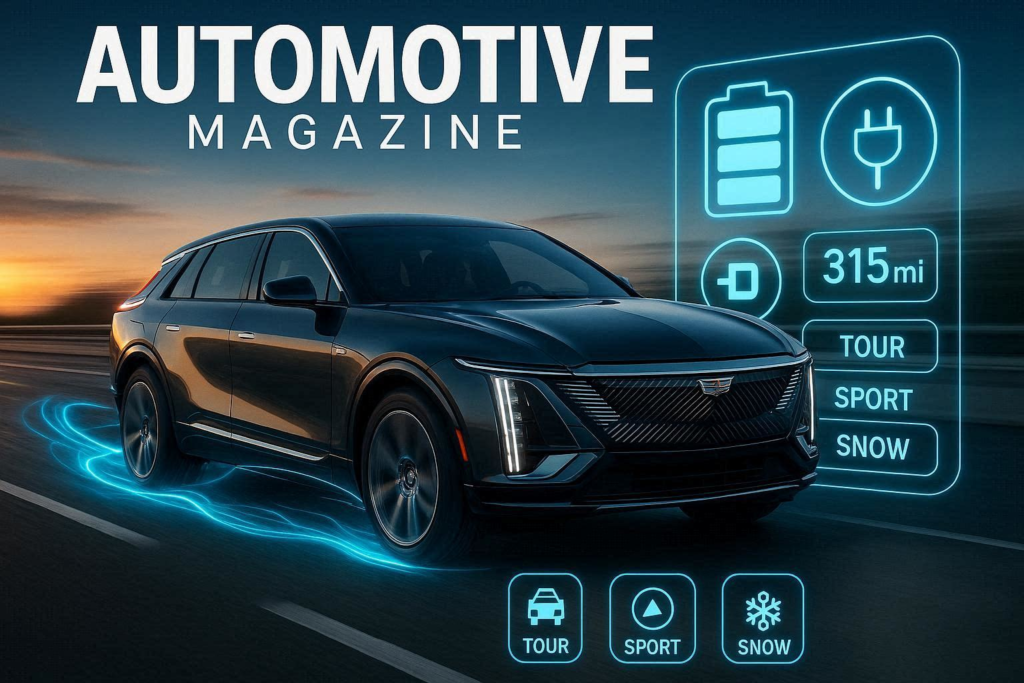
Snow/Ice Mode is designed for challenging weather conditions where traction is limited.
This mode modifies:
- Power delivery
- Traction control sensitivity
- Wheel slip management
- Acceleration characteristics
By reducing sudden power surges, Snow/Ice Mode helps maintain stability on slippery roads. While this mode is not primarily intended to improve efficiency, its smoother power delivery can sometimes help reduce unnecessary energy waste.
However, winter conditions themselves usually decrease range due to battery temperature effects and increased cabin heating demands. Any efficiency benefits from Snow/Ice Mode are often offset by environmental factors.
One of the most important features affecting battery usage in the Cadillac Lyriq is One-Pedal Driving.
This system increases regenerative braking when the driver lifts off the accelerator pedal. Instead of relying solely on traditional brakes, the vehicle converts kinetic energy back into electricity and stores it in the battery.
Benefits include:
- Enhanced energy recovery
- Reduced brake wear
- Improved driving efficiency
- Better control in many situations
Many EV owners find that One-Pedal Driving helps maximize efficiency, especially during city driving with frequent stops and starts.
Because more energy is recovered during deceleration, drivers may experience improved real-world range compared to conventional driving techniques.
Regenerative braking cannot create new energy, but it can recover energy that would otherwise be lost as heat.
In urban environments, regenerative braking can significantly improve efficiency. Every time the vehicle slows down, a portion of the motion energy is returned to the battery.
The effectiveness of regenerative braking depends on:
- Traffic conditions
- Driving style
- Road terrain
- Vehicle speed
Drivers who learn to use regenerative braking effectively often achieve better efficiency numbers than those who rely heavily on traditional braking.
Many people confuse battery usage with battery capacity.
Battery capacity refers to the total amount of energy stored in the battery pack. This value remains unchanged regardless of driving mode.
Battery usage refers to how quickly that energy is consumed.
An easy analogy is a fuel tank in a gasoline vehicle. The tank size stays the same, but fuel consumption changes depending on how aggressively the vehicle is driven.
Similarly, driving modes affect consumption patterns rather than battery size.
In real-world driving, the difference in range between modes can vary considerably.
Several scenarios illustrate this:
A driver maintaining moderate speeds and smooth acceleration may achieve close to the vehicle’s rated range.
Frequent hard acceleration can increase energy usage substantially, reducing total driving range.
Heavy use of regenerative braking in city traffic may improve efficiency and partially offset energy consumption.
Cold weather often has a larger impact on range than the selected driving mode.
As a result, actual range differences between modes are often smaller than differences caused by driving habits and environmental conditions.
Electric vehicles produce instant torque, which is one of their biggest advantages.
However, rapid acceleration demands large amounts of electrical power. Every strong acceleration event pulls significant energy from the battery.
Sport Mode makes this power more accessible and responsive. Consequently, drivers may use more energy simply because the vehicle encourages quicker acceleration.
This does not mean Sport Mode is inherently inefficient. The actual energy usage depends on how the driver responds to the increased performance.
At highway speeds, aerodynamic drag becomes one of the largest consumers of energy.
Once cruising speed is reached, the selected driving mode often has less impact on efficiency than speed itself.
For example:
- Driving at 65 mph is generally more efficient than driving at 80 mph.
- Speed differences often influence range more than mode selection.
Therefore, maintaining moderate highway speeds remains one of the best strategies for maximizing range.
Battery performance is sensitive to temperature.
Cold weather can:
- Reduce battery efficiency
- Increase heating requirements
- Lower available range
Hot weather may:
- Increase air conditioning usage
- Require battery cooling systems
These environmental factors frequently have a greater impact on range than switching between Tour and Sport modes.
Drivers should consider weather conditions when evaluating real-world efficiency.
Modern electric vehicles use sophisticated software to manage energy consumption.
The Cadillac Lyriq continuously monitors:
- Battery condition
- Motor performance
- Vehicle speed
- Environmental conditions
- Driver inputs
The vehicle’s energy management system seeks to balance performance, safety, and efficiency under all driving modes.
Even in Sport Mode, advanced controls help prevent unnecessary energy waste while still delivering enhanced responsiveness.
Drivers seeking the highest possible efficiency should consider:
- Using Tour Mode
- Driving smoothly
- Maintaining moderate speeds
- Utilizing regenerative braking
- Avoiding unnecessary acceleration
- Keeping tires properly inflated
While no driving mode can magically increase battery capacity, efficient operation can significantly extend usable range.
Perhaps the most important takeaway is that driver behavior often matters more than mode selection.
A careful driver in Sport Mode may achieve better efficiency than an aggressive driver in Tour Mode.
Key habits include:
- Gentle acceleration
- Predictive braking
- Consistent speeds
- Effective use of regeneration
These practices often produce larger efficiency gains than simply switching driving modes.
False. Battery capacity remains unchanged.
Not necessarily. Driving habits still play the biggest role.
False. It recovers a portion of energy that would otherwise be lost.
False. Snow Mode prioritizes traction and stability.
False. Modes influence efficiency, but many other factors contribute to overall range.
To maximize efficiency:
- Use Tour Mode for daily commuting.
- Take advantage of One-Pedal Driving.
- Avoid rapid acceleration whenever possible.
- Monitor tire pressure regularly.
- Precondition the cabin while charging.
- Reduce unnecessary cargo weight.
- Maintain steady highway speeds.
- Use climate controls efficiently.
These strategies can help drivers extract the maximum value from every battery charge.
So, do the driving modes in Cadillac Lyriq offer different ranges or battery usages? The answer is yes, but indirectly. Driving modes do not change the battery’s actual capacity, yet they can influence how efficiently the stored energy is used. Tour Mode generally provides balanced efficiency, Sport Mode may increase energy consumption through more aggressive performance, and Snow/Ice Mode prioritizes traction over efficiency. One-Pedal Driving and regenerative braking can help recover energy and improve overall efficiency.
Ultimately, driving habits, speed, weather conditions, and road environments have a greater impact on range than the selected driving mode alone. Understanding how each mode affects vehicle behavior allows Cadillac Lyriq owners to make informed choices and optimize both performance and efficiency according to their driving needs.
Yes. Driving modes influence how energy is consumed, which can affect real-world range. However, they do not change the battery’s actual capacity.
Tour Mode generally offers the most balanced efficiency and is usually the best choice for maximizing range during everyday driving.
Sport Mode can lead to higher energy consumption because it encourages quicker acceleration and more responsive performance.
Yes. One-Pedal Driving increases regenerative braking and helps recover energy that would otherwise be lost during deceleration.
Not directly. Snow/Ice Mode focuses on traction and stability. However, winter weather conditions often reduce overall EV range.
No. Regenerative braking only recovers a portion of energy during deceleration and cannot fully recharge the battery.
Highway speed generally has a larger effect on range than driving mode. Higher speeds increase aerodynamic drag and energy consumption.
No. The Cadillac Lyriq is designed to safely operate in all available driving modes without harming the battery.